After months of speculation, Turning Point USA has revealed its lineup for its alternative to the Super Bowl Halftime Show, dubbed the “All-American Halftime Show.”- nganha
its alternative to the Super Bowl Halftime Show, dubbed the “All-American Halftime Show.”- nganha
What began as quiet online chatter and scattered rumors crystallized into a formal announcement that immediately commanded national attention.
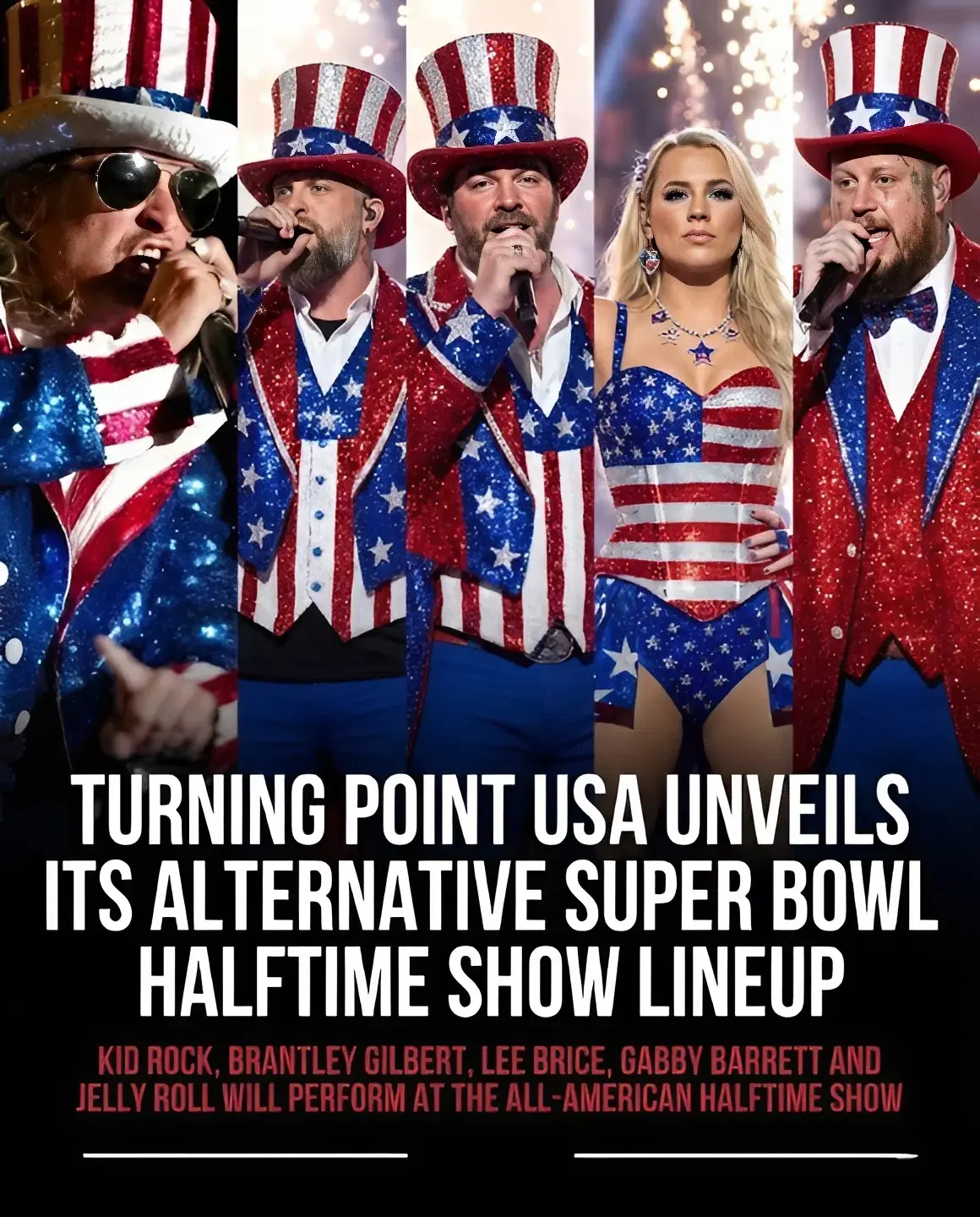
Turning Point USA’s decision to brand the event as the “All-American Halftime Show” signals an intentional departure from the mainstream entertainment model typically associated with Super Bowl Sunday.
By anchoring the lineup with Jelly Roll, the broadcast taps into an artist whose career narrative already resonates deeply with themes of redemption, personal responsibility, and resilience—ideas that align closely with the event’s stated values.
Jelly Roll’s rise has been anything but conventional. Emerging from a background that blends hip-hop, country, and Southern rock, he built his audience outside the traditional industry pipeline.
His music often confronts addiction, incarceration, faith, and the struggle to rebuild one’s life after failure.
Critics, however, questioned the broader implications. Some argued that positioning Jelly Roll within a politically branded broadcast risks narrowing the interpretation of his music, which many fans see as universal rather than ideological.

Others suggested that any alternative halftime show, regardless of messaging, inevitably becomes part of the culture war surrounding the Super Bowl.
Yet even among skeptics, there was acknowledgment that Jelly Roll’s authenticity complicates easy categorization.
Alternative streams, digital broadcasts, and parallel programming now compete for attention. The “All-American Halftime Show” leverages that fragmentation, offering audiences a choice rather than a replacement.
Jelly Roll’s inclusion ensures that choice will be taken seriously.
Industry analysts note that Jelly Roll brings with him an audience that is both deeply loyal and highly engaged.
His live performances are known for their emotional intensity rather than spectacle, relying on storytelling and connection instead of elaborate staging. That approach aligns with the broadcast’s stated emphasis on values over visuals.
Rather than attempting to outdo the NFL’s production scale, the alternative show appears focused on emotional resonance.
Culturally, Jelly Roll’s presence also underscores a broader shift in American music.
Artists who once existed on the margins—blending genres, bypassing traditional gatekeepers, and speaking openly about personal struggle—are now central to national conversations.
For Jelly Roll himself, the opportunity represents another step in a career defined by unlikely moments. Friends and collaborators describe him as acutely aware of the responsibility that comes with visibility.
In that sense, the “All-American Halftime Show” becomes another chapter in a larger narrative about voice and redemption.
Ultimately, the reveal has achieved what any major entertainment announcement hopes to do: it has captured attention and sparked conversation.
Whether embraced or challenged, the moment reflects a cultural landscape where music, identity, and values intersect in increasingly visible ways.
And with Jelly Roll leading the lineup, the “All-American Halftime Show” positions itself not merely as a counter-program, but as a statement—one that invites viewers to consider what kind of stories they want amplified on America’s biggest night.
The inclusion of Jelly Roll in the lineup is more than a mere musical choice; it is a strategic masterstroke aimed at a public increasingly hungry for authenticity in an era of hyper-polished production.
When the lights of the “All-American Halftime Show” finally go up, the expectation is not for a display of pyrotechnics, but for a raw musical space where the scars of the past are worn as badges of resilience.
This event sets a significant precedent in how mass culture is consumed. Rather than accepting a single “menu” of entertainment from traditional broadcast networks, audiences are beginning to fragment based on personal value systems.
Turning Point USA has accurately identified this shift: they aren’t attempting to outshine the NFL with cinematic gimmicks or a massive budget, but rather by creating an “oasis” for those who feel alienated by mainstream cultural currents.
Jelly Roll, with his gravelly voice and confessional lyrics, serves as the perfect bridge between rebellion and faith, between transgression and redemption.
Looking ahead, the success of this broadcast will serve as a barometer for the strength of the “parallel economy” within the entertainment industry.
If viewership reaches a breaking point, it will prove that messages of identity and traditional values possess a mobilizing power equal to that of A-list pop icons.
This could signal the dawn of an era where major events are no longer a monologue, but a multi-dimensional dialogue where artists like Jelly Roll represent the audience’s freedom of choice.
Super Bowl Sunday is no longer just a battle on the gridiron; it is a clash between two distinct visions of contemporary American culture.
The internet is ablaze with a sensational claim alleging that Senator Marco Rubio is selling a lavish Oklahoma mansion on “stolen land” to a Native tribe for a fraction of its value.
Supporters hail the story as a rare moral reckoning by a powerful politician, while critics warn it may be exaggerated, misleading, or entirely false, engineered for clicks rather than truth.
At the heart of the controversy is a viral post asserting that Rubio